Governance before automation: why the order matters
Automating a process you haven't governed makes its problems faster and harder to spot. Here's why governance comes first, and why it speeds growing businesses up.
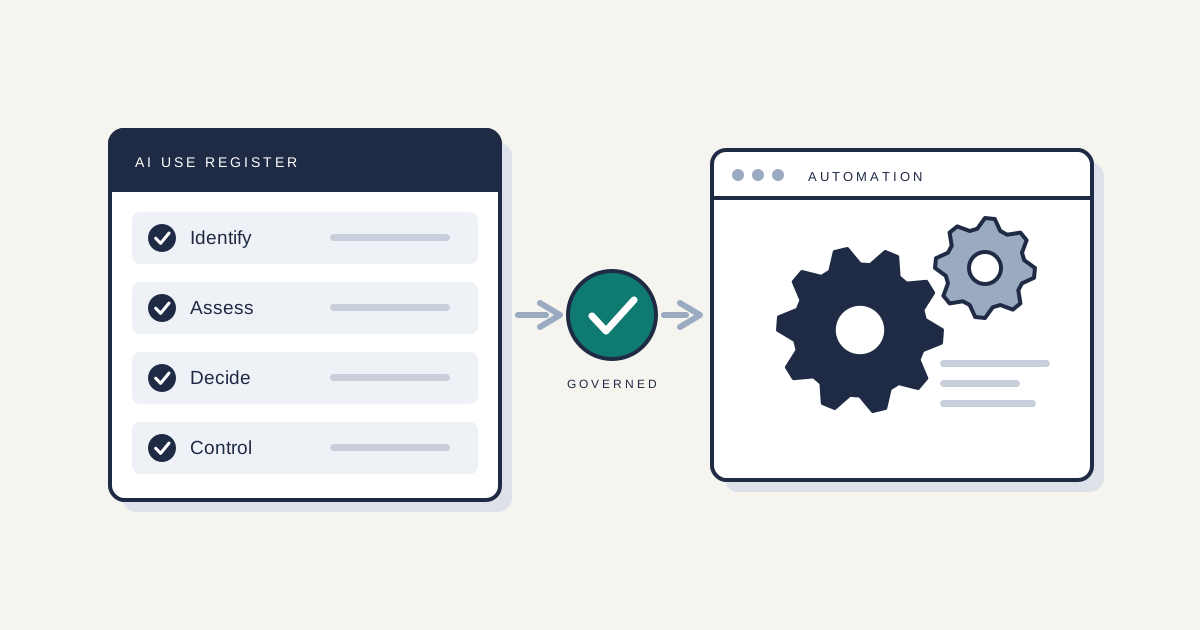
Automation amplifies whatever you give it. Give it a clear process, a named owner and controlled data, and it does that work faster. Give it a process nobody has thought through, and it does that faster too. That's the whole argument for putting governance first, and it applies most to businesses that are growing quickly.
Picture a familiar scene. Someone in customer service finds an AI tool that drafts replies. It's good. Within a fortnight it's being used in sales follow-ups and in complaint handling as well. Nobody decided what customer data it could see. Nobody checked the supplier's terms. Nobody owns the question "what happens when it gets something wrong?" None of this is reckless. It's what happens when a useful tool meets a busy team.
Now automate that. Connect the tool to the inbox so replies go out without a person reading them first. The gaps don't close. They scale.
What we mean by governance
Not a 60-page policy. For a growing business, governance before automation comes down to four things:
- Know what you're using. A simple record of the AI tools in the business, who uses them and for what.
- Understand the risk. Which uses touch customers, personal data, money or decisions about people?
- Decide, and name an owner. A clear yes, no or "yes, with conditions", and one person accountable for each use.
- Put proportionate controls in place. A review step where outputs reach customers. Rules on what data goes in. A way to raise a problem.
These are the first four stages of The Edge AI Governance Cycle™: Identify, Assess, Decide and Control. Automation belongs after them, not before.
Why the order matters
You can't control what you can't see. If you don't know an AI tool is drafting complaint responses, you can't check whether it's getting them right. Automating an untracked use removes the last person who might have noticed.
Fixing it later costs more. Once a process is automated, it has dependencies: integrations, supplier contracts, staff who've stopped doing the task by hand, customers who've already had the output. Changing course means unwinding all of that. Deciding up front is cheaper. That's our view from practice, and it's the logic behind most management-system thinking.
Your buyers will ask. If you sell an AI product to larger organisations, their procurement and security teams increasingly ask how you govern it: what AI you use, how you assess risk, who can override it. A business that governed first can answer from records. One that automated first has to reconstruct the answers. (Our view, based on the due-diligence questionnaires we see.)
Governance creates the conditions for value
The usual objection is speed. Governance sounds like the thing that slows a small team down. In practice the opposite is true more often than not.
When people know what's allowed, they stop guessing. They don't hold back from a useful tool because they're unsure, and they don't quietly use one they shouldn't. Clear boundaries make decisions quicker. A named owner means a problem gets fixed in a day rather than discussed for a month.
It also makes for better automation. Once AI use is recorded and monitored, you can see where it's working, where people are repeating the same checks and where a process is ready to run with less manual effort. In our method, automation candidates come out of the Improve stage, and they go back through Identify and Assess before anything is switched on. The order protects the value you're trying to create.
The supporting frameworks point the same way. ISO/IEC 42001:2023, the international standard for AI management systems, sets requirements for establishing, running and continually improving AI management inside an organisation. The NIST AI Risk Management Framework treats "Govern" as a function that runs across everything else. Neither tells a small business to slow down. Both assume you know what you're running before you scale it.
Where to start
Start with what you already have. List the AI tools in use, mark the ones that touch customers or personal data, and give each one an owner. That takes an afternoon, not a quarter. Then decide which processes are worth automating, and put a control around each one before it goes live.
Governance first isn't caution for its own sake. It's how a growing business makes sure the speed it gains from AI is speed in the right direction.
What this means for
- AI startups selling to enterprise: No new legal obligation. ISO/IEC 42001 (international, voluntary) and the NIST AI RMF (US, voluntary) are reference points enterprise buyers commonly use in due diligence, so records of what you use, how you assess it and who owns it make those conversations shorter.
- Startups implementing AI governance: No new legal obligation. Recording AI use and naming owners before automating gives you a base that scales as headcount grows.
- SMEs implementing AI governance: No new legal obligation. A simple AI use register and a review step for customer-facing outputs cover most of the early risk without specialist staff.
Not sure what you'd find? Book an AI Governance Health Check and we'll show you where you stand before you automate.
This is general information, not legal advice.
Sources
| Reference | Jurisdiction | Official source | Label |
|---|---|---|---|
| ISO/IEC 42001:2023, Information technology: Artificial intelligence: Management system (Edition 1, published 18 December 2023) | International | https:// | Confirmed |
| NIST AI 100-1, Artificial Intelligence Risk Management Framework (AI RMF 1.0), published 26 January 2023. "Govern" is one of four functions (Govern, Map, Measure, Manage) and is described as cross-cutting. Evidence is over three years old; the framework remains NIST's current version. | US | https:// | Confirmed |
| Claims about enterprise buyer questions and the cost of later fixes | n/a | Edge AI Partners practice | Our view |